

California commercial truck insurance requirements are set by the Motor Carrier Permit (MCP) program. Most carriers that need an MCP must carry $750,000 in liability, with lower limits for small vehicles and up to $5,000,000 for the riskiest hazardous materials. Your insurer files proof with the DMV, and your permit is suspended if that coverage lapses.
Insurance for a single truck in California typically costs about $15,000 a year for a full coverage package, and much more for new authorities and high-risk freight. This guide covers who needs an MCP, California’s limits by cargo, the filings involved, what California truckers pay, and why the state costs more than most.
Get Your Free Quote Started

California Motor Carrier Permit Requirements
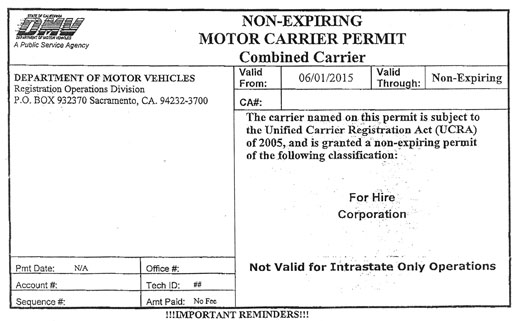
You need a California Motor Carrier Permit if you operate any of the following:
- Any vehicle hauling property for hire, at any size
- A commercial vehicle with a gross vehicle weight rating of 10,001 pounds or more
- Any vehicle hauling hazardous materials
- A truck and trailer combination over 40 feet long
- Any vehicle that requires a commercial driver’s license
Non-commercial pickups under 11,500 pounds and non-commercial two-axle trucks under 26,001 pounds are generally exempt. You can apply through the MCP application online; the DMV’s full rules are here.
Steps To Get Operating In California
- Get a USDOT number. California requires one even for carriers that never leave the state.
- Get a CA number from the CHP. It’s issued after you submit a Motor Carrier Profile and doubles as your MCP number.
- Buy liability insurance at the limit your cargo requires, and have your insurer file a Certificate of Insurance (Form MC 65 M) with the DMV.
- Show workers’ comp coverage, or file an exemption if you have no employees.
- Enroll drivers in the DMV’s Employer Pull Notice (EPN) program if required, so you’re notified of changes to their driving records.
Carriers running trucks of 26,001 pounds or more, truck tractors, combinations over 40 feet or hazmat vehicles also fall under the CHP’s Basic Inspection of Terminals (BIT) program.
California Truck Insurance Requirements By Freight Type
| Operation | Minimum Liability (Combined Single Limit) |
|---|---|
| Property carrier using only vehicles under 10,000 lbs, no hazmat | $300,000 |
| General freight | $750,000 |
| Oil, hazardous waste and most hazardous materials | $1,000,000 |
| Bulk hazardous substances or compressed gas in large tanks, certain explosives, poison gas, highway-route-controlled radioactive materials | $5,000,000 |
Source: California Vehicle Code s. 34631.5 and the DMV’s Motor Carrier Permit rules, which list required limits from $300,000 to $5,000,000.
The insurer must file proof with the DMV, and the certificate can’t be cancelled on less than 30 days’ notice. If coverage is cancelled, the DMV suspends your MCP until new coverage is filed. Light trucks that don’t need an MCP fall under California’s standard auto minimums, which rose to $30,000/$60,000/$15,000 in 2025.
California Vs Federal Requirements
California’s $750,000 general freight minimum matches the federal minimum for interstate for-hire carriers. If you also run interstate, you need FMCSA operating authority with your liability filed federally too. Most brokers require $1,000,000 in liability and $100,000 in cargo regardless of the legal minimum. See FMCSA minimum insurance requirements and federal BIPD requirements.
How Much Does Commercial Truck Insurance Cost In California?
| Situation | Typical Monthly Cost In California |
|---|---|
| Owner-operator leased to a carrier | $250–$1,800+ |
| Own authority, liability only | $700–$3,000+ |
| Own authority, full coverage | $1,200–$5,000+ |
Ranges are directional figures from a 2026 California guide by LogRock. A 2026 Truck Writers report estimated about $15,200 a year per truck for a full coverage package in California. New authorities, hazmat and high-theft freight sit at the top of these ranges.
Why Truck Insurance Costs More In California
- Cargo theft. California led the country in 2025 with 1,218 cargo thefts recorded by CargoNet, nearly half of all U.S. and Canadian incidents. Kern and San Joaquin counties saw sharp increases.
- Large verdicts. California is among the states with the highest median awards in trucking lawsuits, which drives up liability pricing.
- Traffic and congestion in Los Angeles, the Inland Empire and the Bay Area.
AB5 And Leased Owner-Operators
California’s AB5 independent contractor law, upheld again by the Ninth Circuit in 2025, has made it much harder for carriers to lease owner-operators in California, and many in the industry say it has pushed owner-operators toward running under their own authority. That means buying the full insurance program themselves rather than non-trucking liability and physical damage alone. Budget for that before you change how you operate.
California Truck Insurance By Truck Type
| Truck Type | What To Know In California |
|---|---|
| Semi truck | $750,000 MCP minimum for general freight; brokers expect $1,000,000 and $100,000 cargo. |
| Box truck | Needs an MCP if it hauls for hire or is rated 10,001 lbs or more. Most 26-foot box trucks qualify. |
| Port drayage | Container hauling at Los Angeles, Long Beach and Oakland requires UIIA coverage: $1,000,000 auto liability, $1,000,000 general liability and trailer interchange. |
| Dump truck | MCP limits apply; contractors usually require $1,000,000, and some public works jobs require $2,000,000. |
| Hazmat | $1,000,000 to $5,000,000 depending on the material. |
| Hot shot | For-hire hot shots need an MCP at any size; interstate work adds federal authority. |
| Tow truck | Tow trucks of 10,001 lbs or more need an MCP, and cities and the CHP rotation program set their own on-hook and liability requirements. |
Because California leads the country in cargo theft, check your cargo coverage closely. See motor truck cargo insurance for exclusions that matter, and cargo insurance rates for costs.
Truck Insurance In California’s Freight Hubs
- Los Angeles and Long Beach. The Port of Los Angeles handled 10.2 million containers (TEUs) in 2025, the top U.S. import gateway. Drayage here means UIIA coverage and heavy congestion, and Los Angeles garaging is among the most expensive in the state.
- The Inland Empire. Ontario, Fontana and San Bernardino form one of the largest warehouse regions in the country, with heavy box truck and regional traffic.
- The Bay Area and Oakland. Port drayage plus dense urban traffic.
- Sacramento and the Central Valley. Sacramento, Stockton, Fresno, Bakersfield and the I-5 and CA-99 corridors carry agricultural and distribution freight. Kern and San Joaquin counties saw some of the biggest cargo theft increases in 2025.
- San Diego and Otay Mesa. One of the busiest commercial border crossings on the southern border.
Coverage California Truckers Should Carry
- Primary liability at your MCP limit, filed with the DMV
- Physical damage on your truck and trailer, required by lenders
- Motor truck cargo, usually $100,000, with theft conditions you can meet
- Workers’ compensation, required for the MCP if you have employees
- General liability, often required by shippers and ports
Compare carriers in our commercial truck insurance companies directory, including our Progressive review. Running interstate? Browse all state requirements.
CA Frequently Asked Questions
What Are California’s Commercial Truck Insurance Requirements?
Carriers that need a California Motor Carrier Permit must carry $750,000 in liability for general freight, $300,000 if they only run vehicles under 10,000 pounds, and $1,000,000 to $5,000,000 for hazardous materials. The insurer files proof with the DMV.
Who Needs A Motor Carrier Permit In California?
Anyone hauling property for hire, plus anyone operating a commercial vehicle of 10,001 pounds or more, a hazmat vehicle, a combination over 40 feet, or a vehicle that requires a CDL.
How Much Is Commercial Truck Insurance In California?
A full coverage package for one truck runs about $15,000 a year on average, and owner-operators with their own authority often pay $1,200 to $5,000 or more a month depending on freight, record and authority age.
Do California Intrastate Truckers Need A USDOT Number?
Yes. California requires a USDOT number even for carriers that only operate within the state, and the CHP issues a CA number that serves as your MCP number.
Why Is Truck Insurance So Expensive In California?
California leads the country in cargo theft, has some of the highest trucking lawsuit awards, and has heavy congestion around its ports and cities. AB5 has also made leasing on harder, and running your own authority means buying the full insurance program.
Get Your Free Quote Started